
.WEBP)
Setup a consultation
Recent Posts


Salesforce managed services have reached a critical development point. Businesses must choose between traditional human-led support and emerging AI-powered solutions. Traditional services rely on experienced consultants who provide personalized guidance. AI-powered alternatives utilize automation and predictive intelligence for faster issue resolution. Each approach offers distinct advantages, and the right choice depends on your organization's specific requirements, budget and technical complexity.
Salesforce managed services providers handle the ongoing maintenance, optimization, and support of a company's Salesforce environment. These services free internal IT teams to focus on strategic initiatives while external specialists manage platform updates, user support, customization requests, and technical troubleshooting.
Traditional salesforce managed services rely on human expertise to manage Salesforce implementations. IT staff works directly with the salesforce managed services provider to diagnose issues, implement solutions, and maintain system health. These providers follow processes refined through years of experience and deliver consistency and reliability in their service.
The traditional model centers on manual intervention. Consultants manually code and test solutions when a workflow needs adjustment or a dashboard requires configuration. This hands-on approach allows for individual-specific support tailored to complex business needs. Each client receives dedicated attention from specialists who understand their unique Salesforce environment and business processes.
AI-powered salesforce managed services use artificial intelligence and machine learning algorithms to automate routine tasks. These systems continuously monitor Salesforce environments, predict potential problems, and execute solutions autonomously instead of waiting for human consultants to identify issues.
The automation extends beyond simple monitoring. AI-powered providers optimize tasks and processes that traditionally required manual configuration. Machine learning algorithms analyze usage patterns and identify inefficiencies. They recommend improvements. Therefore, these systems can update records, summarize meetings, handle customer queries, and maintain data quality with minimal human intervention.
Traditional salesforce managed services excel at handling complex, nuanced business requirements. AI-powered alternatives deliver speed and efficiency for standardized processes. Organizations evaluating salesforce managed services pricing must think about these operational differences alongside cost structures.
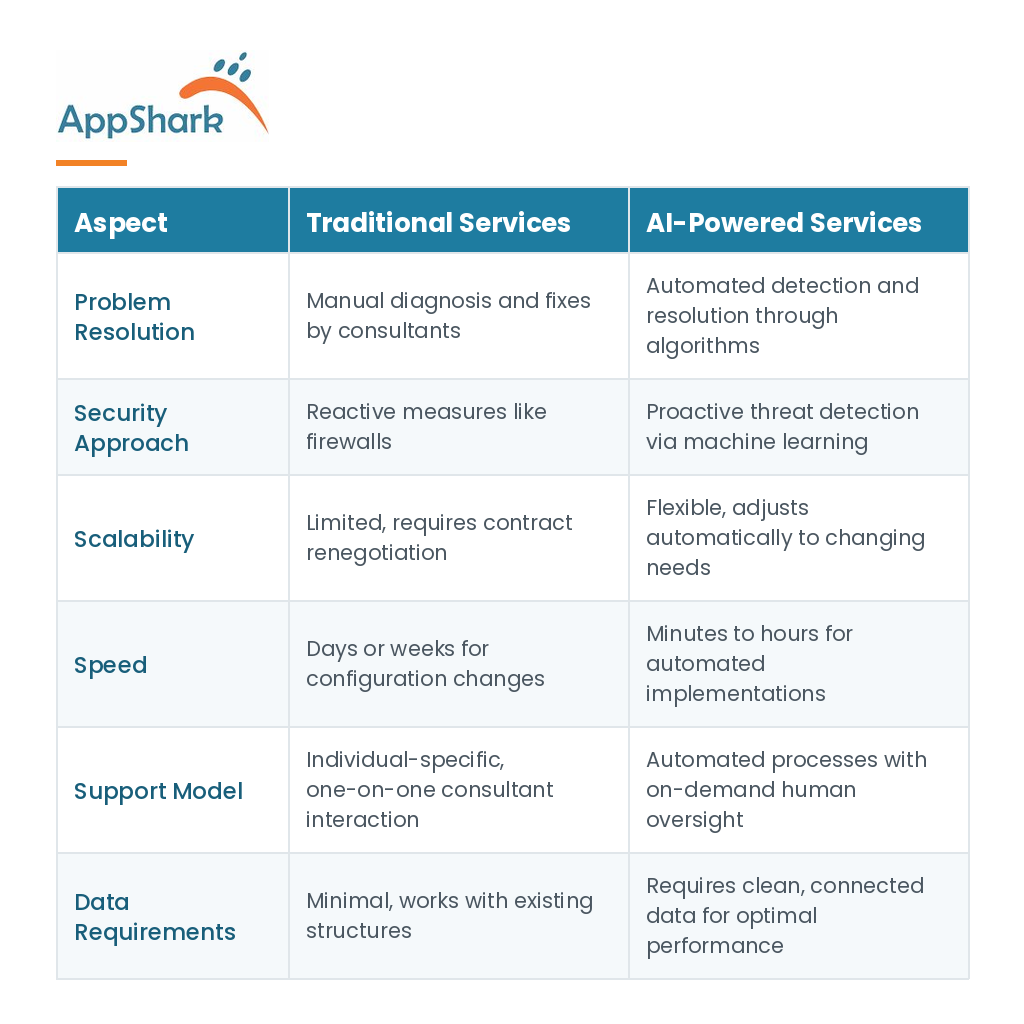
Traditional salesforce managed services deliver value through direct human expertise and offer businesses a proven path to Salesforce optimization. The model relies on specialists who bring years of platform experience and proven methodologies to every client engagement.
A salesforce managed services provider using traditional methods offers three foundational advantages. Personalized support remains the life-blood, with consultants working directly with internal teams to diagnose issues and implement tailored solutions. Established processes provide consistency and reliability, built from procedures refined across many implementations. Flexibility allows customization for specific applications or systems that don't fit standardized approaches.
The hands-on approach creates meaningful partnerships between businesses and their salesforce managed services partner. Consultants invest time understanding unique workflows, data structures and business objectives. This deep familiarity proves valuable for companies with complex Salesforce environments that require nuanced configuration decisions.
Proven processes ensure predictable service delivery. A salesforce managed services specialist follows documented procedures for common tasks and reduces variability in outcomes. These time-tested methods deliver greater consistency compared to experimental approaches, especially when organizations prioritize stability.
Traditional services face inherent constraints. Manual intervention makes the model labor-intensive and requires consultants to personally handle configuration changes and troubleshooting. This human dependency creates higher salesforce managed services pricing and slower response times.
Scalability presents challenges as well. Changes in service scope often require renegotiating contracts or service-level agreements, which makes rapid expansion difficult. Security measures tend toward reactive solutions like firewalls rather than predictive threat detection.
Organizations with highly specialized requirements benefit most from traditional salesforce managed services packages. Businesses needing custom salesforce cpq managed services or complex salesforce marketing cloud managed services configurations find value in consultant expertise. Companies prioritizing relationship-based support over speed should hire salesforce managed services providers using traditional models.
AI reshapes how salesforce managed services providers deliver support. The change moves them from reactive problem-solving to proactive intelligence. Consultants transform from technical configurators into strategic AI advisors who design intelligent ecosystems powered by technologies like Agentforce, Einstein GPT, and Salesforce Data Cloud.
Modern salesforce managed services partner relationships now focus on creating AI-driven customer experiences and designing autonomous agents. Consultants build predictive business systems that analyze data and forecast outcomes. These systems guide teams toward smarter decisions before challenges arise. This represents a fundamental change from Salesforce functioning as digital storage to becoming a proactive decision-making platform.
AI-powered automation handles routine customer queries and updates records. It summarizes meetings and maintains data quality without manual intervention. Machine learning algorithms optimize processes that previously required days of manual configuration. Proactive security measures detect and respond to threats without human input, whereas traditional approaches rely on reactive tools like firewalls. Some implementations reduce process time from 9 weeks to 5 minutes through intelligent automation.
Tasks requiring days of coding now complete in hours using AI-powered development tools. Consultants using AI for org audits and flow building ship implementations in weeks that previously took months. The salesforce managed services benefits extend to scalability. Systems adjust to changing business needs without contract renegotiation. Internal teams redirect time from fixing technical bottlenecks toward user adoption.
AI delivers results only when supported by clean, connected, and secure data. Even sophisticated AI tools fail to produce meaningful outcomes if proper data governance, integration, and trust protocols are missing. Modern implementations focus on data readiness before deploying AI capabilities.
Selecting the right salesforce managed services partner requires matching service capabilities to what your organization needs. Businesses must weigh the advantages and disadvantages of each model against specific operational needs and long-term goals.
Organizations with complex, specialized configurations benefit from traditional approaches where consultants provide hands-on guidance. Companies that prioritize rapid scaling and cost efficiency should assess AI-powered alternatives. The decision hinges on whether individual-specific support outweighs automation speed, or if data quality meets AI requirements for optimal performance.
Traditional salesforce managed services pricing reflects labor-intensive consultant hours. This results in higher baseline costs but predictable service delivery. AI-powered models require a most important upfront investment in hardware and software, though long-term efficiency gains offset original expenses typically. Businesses must balance immediate budget constraints against projected operational savings.
Ask about data governance capabilities, as AI solutions just need clean, connected data foundations. Request case studies that demonstrate implementation timelines, especially when you have industry-specific needs. Clarify security approaches—reactive measures versus proactive threat detection—and confirm scalability options without contract renegotiation requirements.
Both traditional and AI-powered salesforce managed services deliver value, though through different approaches. Organizations that prioritize customized support and complex customization should lean toward traditional providers. Businesses seeking automation and rapid scalability benefit from AI-driven solutions. Companies must assess their data readiness and budget constraints before committing. The right salesforce managed services partner lines up service capabilities with specific business requirements. This ensures platform performance and returns on investment.
Ready to optimize your platform performance? Contact AppShark today to discuss how our tailored service solutions can drive measurable returns for your business.
Visit www.appshark.com or reach us at sales@appshark.com
Q1. What is the main difference between traditional and AI-powered Salesforce managed services? Traditional Salesforce managed services rely on human consultants who manually diagnose issues and implement customized solutions through hands-on support. AI-powered services use artificial intelligence and machine learning to automate routine tasks, continuously monitor environments, predict problems, and execute solutions autonomously with minimal human intervention.
Q2. How much faster are AI-powered managed services compared to traditional approaches? AI-powered services can complete tasks in minutes to hours that traditionally take days or weeks. Some implementations have reduced process times from 9 weeks to just 5 minutes through intelligent automation. Configuration changes that previously required days of manual coding can now be completed in hours using AI-powered development tools.
Q3. When should a business choose traditional Salesforce managed services over AI-powered options? Traditional services make sense for organizations with highly specialized requirements, complex custom configurations, or unique business processes that don't fit standardized approaches. Companies prioritizing relationship-based support, personalized consultant interaction, and stability over speed should consider traditional managed services providers.
Q4. What are the data requirements for AI-powered Salesforce managed services to work effectively? AI-powered services require clean, connected, and secure data to deliver meaningful results. Without proper data governance, integration, and trust protocols, even sophisticated AI tools will fail to produce optimal outcomes. Organizations must ensure their data quality meets AI requirements before implementing these solutions.
Q5. How do pricing models differ between traditional and AI-powered Salesforce managed services? Traditional managed services pricing reflects labor-intensive consultant hours, resulting in higher baseline costs but predictable service delivery. AI-powered models typically require significant upfront investment in hardware and software, though long-term efficiency gains and operational savings usually offset the initial expenses over time.