

Setup a consultation
Recent Posts


Salesforce CPQ helped businesses structure complex quoting, while Revenue Cloud Advanced, or RCA, expanded the process across configuration, pricing, and revenue operations. Agentforce Revenue Management, or ARM, brings these capabilities into a more connected, agent-assisted experience.
For teams comparing Agentforce Revenue Management vs Salesforce CPQ, the difference is easier to understand through a complete quote-to-cash workflow than a list of features.
Consider a manufacturing quote for industrial motors and drive components used in a hazardous environment. Product and pricing data first sync from the ERP into Salesforce, giving sales teams current catalog information. From there, ARM manages product configuration, pricing, quote creation, and downstream ERP activity.
Here are six capabilities handled inside that process.
In complex manufacturing sales, certain product combinations may be technically unsupported or unsafe.
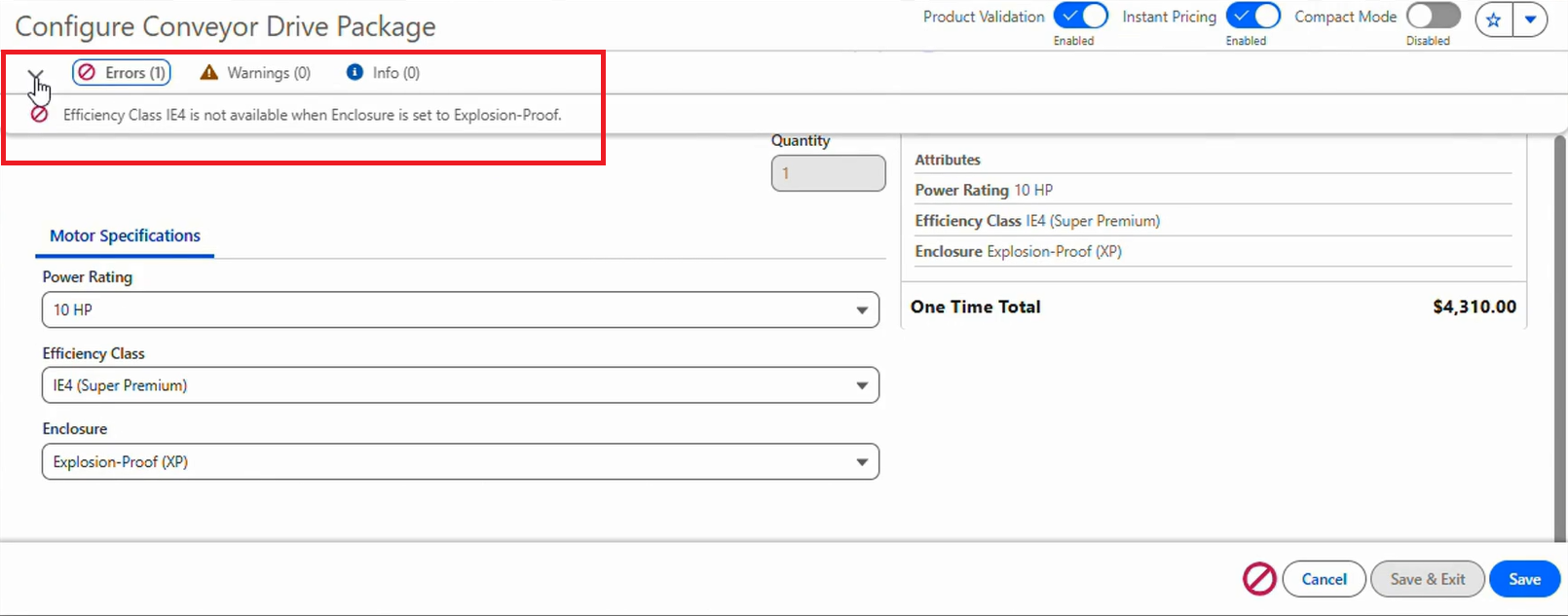
In this scenario, the motor requires an explosion-proof enclosure. When the rep selects an IE4 efficiency class with that enclosure, the system immediately flags the combination as invalid.
The Advanced Configurator applies qualification rules while the quote is being built, preventing unsupported product configurations from progressing. This brings technical and safety requirements into the sales process instead of relying on the rep’s memory or a later review.
A configured product rarely has one fixed price. Changes to efficiency class, enclosure, or other attributes can affect the final amount.
ARM recalculates pricing as those attributes change. The rep does not need to leave the quote, create another version, or trigger a separate pricing step. The amount on screen reflects the product currently being configured.
This real-time price recalculation in Salesforce keeps the commercial effect of every decision visible while reducing offline calculations and inconsistencies between configuration and price.
The same product may require different pricing for a distributor, direct buyer, or strategic account. That does not need to mean duplicate products or separate catalogs.
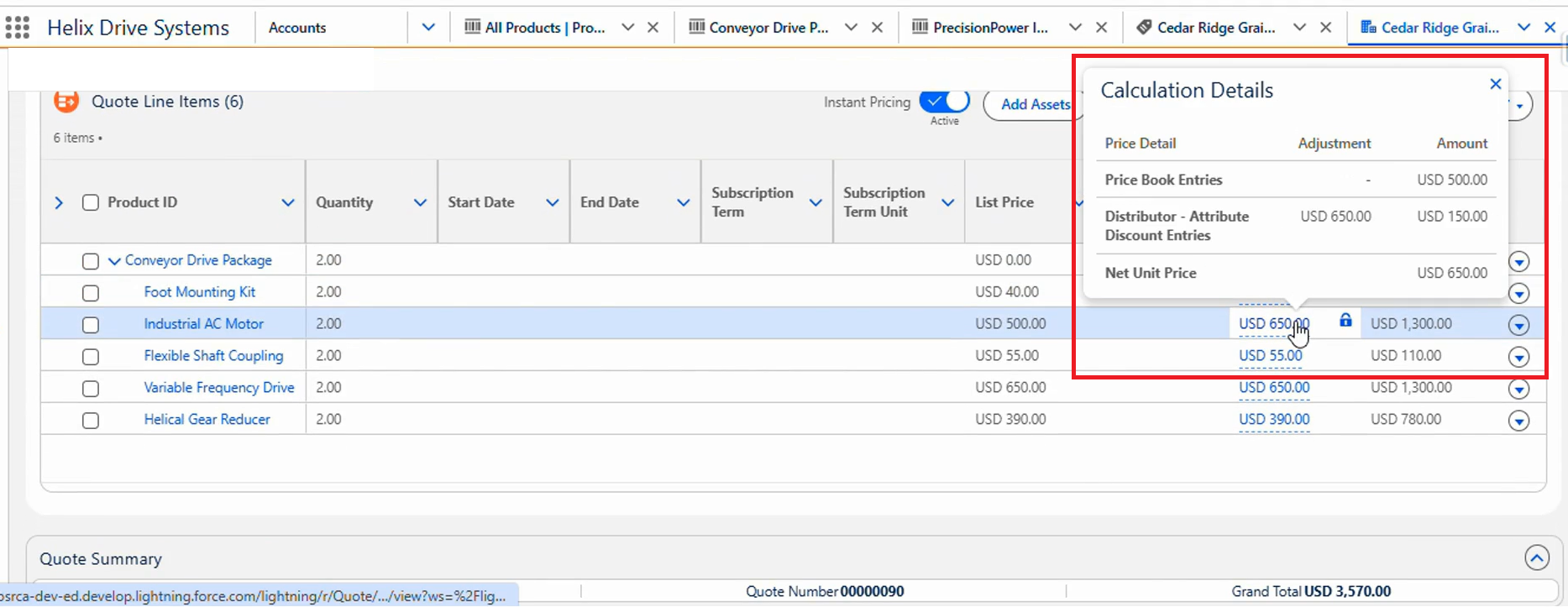
In this workflow, an account classified as a distributor automatically receives the appropriate price for the same configured product. ARM applies pricing based on customer type while the business maintains one product catalog and price book.
This gives sales the correct customer-specific price while allowing Revenue Operations to control pricing logic and reduce manual overrides.
Industrial products are often sold as packages. A conveyor drive package, for example, may include a motor, variable frequency drive, gear reducer, and other required components.
When the rep adds the bundle, ARM automatically adds all required child products to the quote. The rep does not need to search for or select each item separately.
This Salesforce bundle configuration capability speeds up quoting, reduces incomplete packages, and preserves the full bundle structure for fulfillment teams.
Quoting does not have to begin with a long form or multiple record searches.
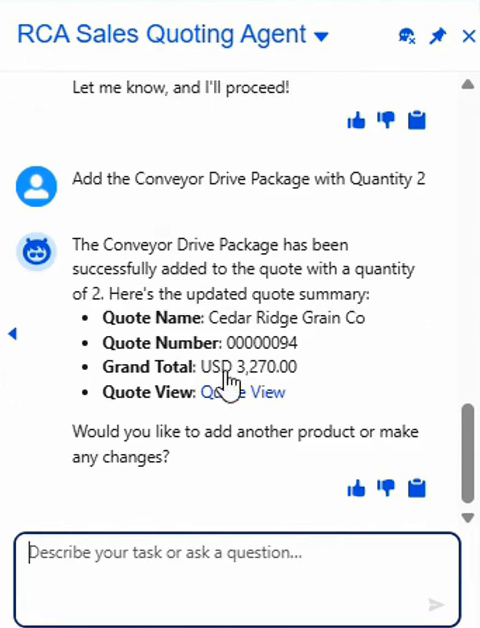
The rep asks the agent to create a quote. When the account is missing, the agent requests it, presents matching records, and creates the quote after the rep selects the correct one. The rep can then add a bundled product and quantity using plain language.
Agentforce Revenue Management turns the conversation into quote and line-item creation while the underlying account, pricing, product, and qualification rules remain in place.
The ability to create a quote using natural language in Salesforce simplifies the rep experience without weakening process control.
The process does not end when the quote document is generated.
Once completed, the quote synchronizes with the related opportunity and creates the corresponding line items. The opportunity and products then move into the ERP, where the sales order and fulfillment process continue.
Invoices and invoice line items sync back into Salesforce. When payment is recorded in the ERP, the payment record, payment line items, and payment check information return as well.
This Salesforce ERP sync across quote-to-cash keeps the full deal visible from the platform where the sales process began, even after fulfillment and finance take over.
These capabilities show why Agentforce Revenue Management is broader than a traditional quoting tool. It governs product configurations, recalculates prices, applies customer-specific pricing, builds complete bundles, supports conversational quote creation, and connects Salesforce with downstream ERP activity.
For manufacturers, the value is not limited to generating quotes faster. It is a more accurate, controlled, and visible revenue process from product selection through payment.
For businesses moving from Salesforce CPQ or Revenue Cloud Advanced, ARM also creates an opportunity to rethink how product rules, pricing, agent interactions, and ERP integrations work together.
AppShark helps organizations assess, implement, and optimize Agentforce Revenue Management across configuration, pricing, quoting, and ERP integration.
Talk to AppShark about building a connected quoting and revenue process around the way your products, pricing, and sales teams actually work.
Connect with us today at sales@appshark.com